

Steel Structure
Common Structural Forms in Steel Construction
Steel structures come in various configurations, each tailored to different spatial, load-bearing, and architectural needs.
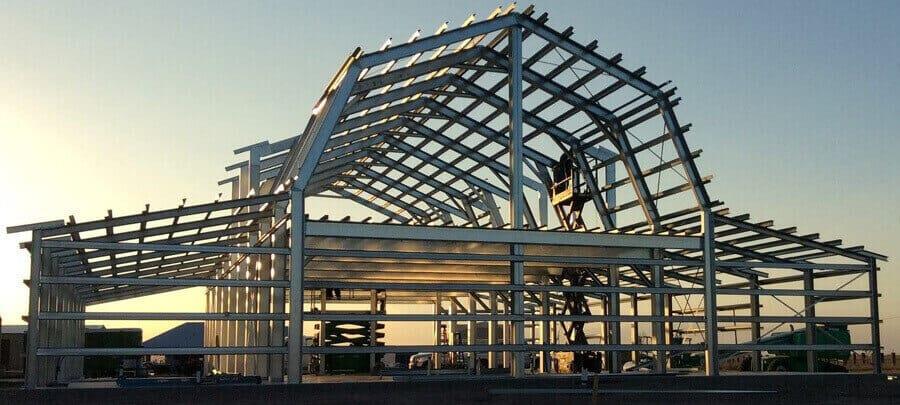
Advantages of Steel Constructions:
- High Strength-to-Weight Ratio
Steel offers exceptional strength relative to its weight, enabling the design of slender, lightweight structures that can support substantial loads without excessive material use. This advantage is particularly valuable in long-span constructions like stadium roofs and airport terminals.
- Rapid Construction
Thanks to prefabrication in controlled factory environments and efficient on-site assembly, steel structures can be erected in a fraction of the time required for traditional materials, significantly accelerating project schedules.
- Design Flexibility
The malleability of steel accommodates complex architectural forms, intricate facades, and innovative spatial designs. From soaring skyscrapers to gracefully curved bridges, steel adapts to a wide range of aesthetic and functional demands.
- Long-Term Durability
When protected against corrosion, steel structures demonstrate remarkable longevity, maintaining their strength and stability for decades even in challenging environments.
- Sustainability
As one of the most recyclable construction materials, steel plays a crucial role in sustainable building practices, supporting the circular economy through repeated reuse without loss of performance.
- Mechanical Properties
- Tensile Strength:
Critical for determining a structure’s capacity to resist pulling forces, assessed through standardized stress–strain testing. - Hardness:
A measure of surface resistance to indentation or scratching, evaluated using Brinell, Vickers, or Rockwell hardness tests. - Toughness:
Reflects a material’s ability to absorb energy during impact, directly related to fracture resistance under sudden loads. - Fatigue Strength:
Defines the endurance limit of steel under cyclic loading, crucial for structures subjected to repetitive stress like bridges and offshore platforms. - Corrosion Resistance:
Enhanced through alloying, galvanization, or protective coatings, ensuring the longevity of steel components in harsh environments.
- Manufacturing and Forming
Unlike concrete, steel is not molded on-site. Structural steel elements are manufactured through hot or cold rolling processes in precision-controlled industrial mills, resulting in a wide array of standardized sections:
- Universal beams (H- and I-sections)
- Channels, angles, and tees
- Circular and rectangular hollow sections (tubular forms)
- Prefabricated trusses, girders, and specialized node assemblies
Prefabrication allows for consistent quality control, dimensional precision, and faster on-site integration, contributing to the overall efficiency of steel construction.
Below are the most commonly used structural forms in modern construction that ICF can provide:

Frame Structure
Frame structures consist of rigidly connected steel beams and columns that form a moment-resisting framework.

Steel Truss Structure
Trusses are triangulated steel assemblies made from slender members joined at nodes.

Light Steel Frame Structure
This steel structure system utilizes cold-formed, thin-gauge steel sections to create lightweight, yet strong and durable building frames.